
Introduction
Over the past decade, the automotive industry has invested heavily in connected vehicle technologies. Nearly every major automotive brand now offers a mobile application that allows customers to monitor vehicle status, remotely control selected functions, schedule services, or receive maintenance notifications. These applications have become an expected part of the modern vehicle ownership experience.
But in many connected app discussions, the roadmap still starts from the vehicle: what signal is available, what command can be exposed, what service can be added, and what screen the app should show. That approach is understandable. Connected apps are built on vehicle capabilities. But customers rarely think in that sequence.
Consumers no longer compare automotive apps only with those from other vehicle manufacturers. They compare them with the digital experiences they use every day—from banking and retail to travel, health, and smart home platforms. They expect applications that are intuitive, personalized, proactive, and capable of simplifying everyday life rather than simply providing remote access to a vehicle.
That comparison matters. Customers do not open an OEM app because they want to browse connected capabilities. They open it because they have a question, a concern, a task, or a decision to make. The next evolution of OEM apps will depend less on how many features they contain and more on how well they act as digital companions throughout the ownership lifecycle.
Why today’s Connected Apps Are No Longer Enough
Over the past decade, OEM connected apps have evolved significantly. What began as simple remote lock and vehicle locator applications has expanded into sophisticated digital platforms offering battery monitoring, charging management, remote climate control, vehicle health, over-the-air updates, service scheduling, and a growing portfolio of connected services to enhance the customer’s digital relationship with the vehicle. Connected apps evolved alongside connected vehicle technologies, with each new vehicle capability becoming another digital feature within the app. Earlier, many OEMs offered brand apps such as MyMazda, Mopar, and MyPeugeot, mainly for ownership support: manuals, dealer contacts, service information, and basic assistance. As vehicles became more connected, these apps expanded into platforms for remote controls, vehicle status, charging, subscriptions, and service functions. That expansion created more value, but it also created a design risk: the app can slowly become a feature container instead of a customer guide.
In many product planning sessions, this feature-led approach looks logical at first. If the vehicle can provide a battery SOC, location, diagnostic code, or remote command, the natural instinct is to expose that capability in the app. But the customer does not experience these as separate technical capabilities. A low battery alert, a nearby charging option, route planning, payment, and charging status may sit in different parts of the ecosystem, but for the customer they are part of one situation: “How do I complete this journey with confidence?” That is where the companion mindset becomes important.
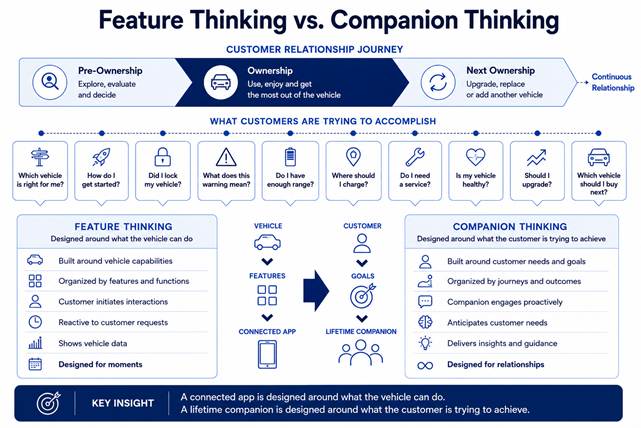
These questions are not tied to individual features. They arise naturally throughout the customer’s relationship with the brand—from pre-ownership, through ownership, and into future ownership decisions. This represents a fundamental shift in perspective. Instead of asking “What capabilities does the vehicle provide?”, OEMs must increasingly ask “What is the customer trying to accomplish?” That shift moves connected experiences beyond individual features and toward a digital companion that helps customers achieve their goals throughout the ownership lifecycle.
The future is not about adding more features to connected apps. It is about evolving from Feature Thinking to Companion Thinking. Companion Thinking does not replace connected features; it gives them purpose.
What makes a digital companion
Moving from Feature Thinking to Companion Thinking is not about adding another layer of connected services. It is about changing the role of the app. A digital companion should help customers manage ownership, connect with the right ecosystem services, and understand what the vehicle is telling them and what action they should take next.
This can be viewed through three complementary dimensions.
Own – A companion makes vehicle ownership simpler and more rewarding. From onboarding and daily vehicle use to maintenance, charging, subscriptions, and future vehicle upgrades, it helps customers confidently manage every stage of ownership.
Connect – A companion extends beyond the vehicle to connect customers with the broader mobility ecosystem, including dealers, service partners, charging networks, insurance providers, financing, and other digital services. It creates a seamless experience across the entire customer journey rather than isolated interactions.
Understand – Perhaps most importantly, a companion transforms vehicle data into meaningful guidance. Instead of presenting technical information or raw telemetry, it explains what the vehicle is telling the customer, recommends appropriate actions, and delivers personalized insights that make ownership easier and more confident.
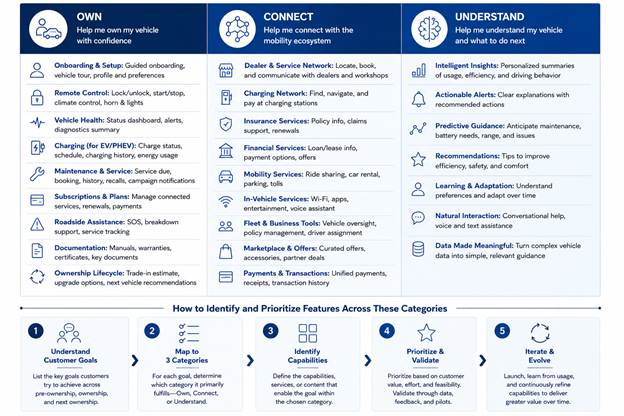
Together, these three dimensions define a digital companion—one that helps customers own with confidence, connect effortlessly, and understand their vehicle throughout an ongoing relationship with the brand.
Building the Foundation for the Experience
The three dimensions of a digital companion, Own, Connect, and Understand, provide a framework for organizing capabilities around the ownership journey. But defining capabilities is only part of the challenge. Customers do not think about ownership, connectivity, and vehicle intelligence as separate functions. They expect every interaction to be intuitive, relevant, and effortless.
This is where experience design becomes the differentiator. Individual features may solve specific tasks, but the overall experience determines whether customers continue to engage with the application over time. Every capability should contribute to a seamless journey that anticipates customer needs, minimizes effort, and provides consistent guidance throughout the ownership lifecycle. In connected app work, the difficult part is not always building the feature. It is deciding whether the feature helps the customer at the right moment, in the right language, with the right next step.
A simple example is vehicle health. A traditional connected app may show a warning, a diagnostic message, or a service reminder. A companion experience would go further. It would explain the issue in customer language, indicate whether the vehicle can still be driven, suggest the nearest appropriate service option, help book an appointment, and keep the customer informed until the issue is resolved. The value is not only in showing vehicle information, but in helping the customer decide what to do next.
To achieve this, OEMs should apply a smaller set of experience principles consistently: start with the customer outcome, reduce effort, use context intelligently, be transparent, and guide customers toward the next best action. These principles ensure that features are not developed in isolation but work together to create a coherent and engaging customer experience.
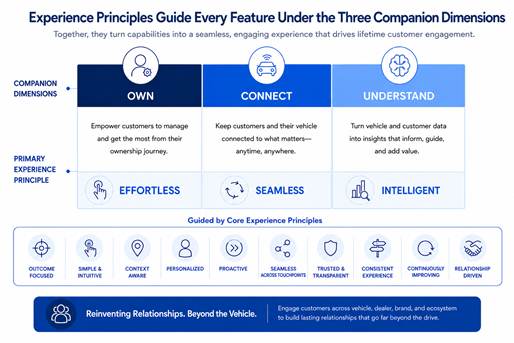
When these principles are applied consistently, the app stops feeling like a set of disconnected screens. It becomes a practical guide across ownership moments: vehicle use, service, charging, dealer interaction, digital services, and future purchase decisions. That is where a companion experience creates real engagement.
Conclusion
Connected vehicle applications have evolved from remote-control tools into sophisticated digital platforms. But the next stage will not be defined by adding more features alone.
By shifting from Feature Thinking to Companion Thinking, OEMs can create digital experiences that help customers Own, Connect, and Understand throughout the ownership journey. Guided by strong experience principles, these capabilities become more than individual functions; they become a trusted companion that evolves with the customer.
For OEMs, this represents more than an opportunity to increase app usage or introduce new connected services. It is an opportunity to build lasting digital relationships that extend well beyond the vehicle and continue throughout the customer’s lifetime. Features attract users. Experiences create engagement.