
Why products with similar capabilities achieve very different customer adoption. Open any app store and the evidence is easy to find. There are dozens of connected vehicle apps which offer remarkably similar features—vehicle location, remote controls, vehicle health and maintenance reminders, yet customer ratings often vary dramatically. The ones scoring 4.5+ don’t appear to offer dramatically more features than those stuck at 3.2. The gap is somewhere else. It lies in something less obvious: customer expectations.
Customers don’t choose products based only on what they do. They also choose them based on how well those products meet their expectations. This same pattern appears across connected mobility—from OEM mobile apps and fleet management platforms to insurance telematics and predictive maintenance solutions. Many products solve similar problems, yet some become market leaders while others struggle to gain adoption.
On the ground, customer expectations remain one of the most overlooked aspects of designing successful connected mobility products.
“Customers Buy Solutions, But Compare Experiences”
When customers first look for a connected mobility solution, they usually focus on the problem they want to solve.
- A vehicle owner wants to stay connected with their car.
- A fleet operator wants better visibility into fleet operations.
- An insurer wants better insight into driving behavior.
- A dealer wants to identify vehicles that require service.
These goals explain why customers choose a particular type of product. However, once multiple products can solve the same problem, something interesting happens. Customers stop comparing products based only on features. Instead, they begin asking a different set of questions.
- Is it easy to use?
- Can I trust the information?
- Is it reliable?
- Does it respond quickly?
- Does it fit naturally into the way I work?
- Is support available when I need it?
- Is it worth paying for?
These questions often determine which product customers ultimately choose.
The Hidden Layer: Customer Expectations
Looking across connected mobility products, a pattern shows up. While these products solve very different problems, customers often evaluate them using a near-identical set of expectations. Whether the customer is a vehicle owner, fleet manager, insurer or dealer, they all expect products to be dependable, easy to use and capable of helping them achieve their objectives with minimum effort. The priorities may differ, but the expectations themselves are remarkably similar. This hidden layer is often overlooked during product design.
Product teams naturally spend significant time discussing capabilities, data models and roadmaps. Teams spend comparatively less time on how customers expect those capabilities to be delivered. That difference can determine whether a product is adopted enthusiastically or quietly abandoned.
A common example seen across connected mobility programs illustrates this well. A product team ships a feature that matches the competitor’s exactly — same data, same refresh rate — yet adoption still lags. On closer investigation, the difference is rarely the feature. It is often something as simple as the competitor’s screen loading in under two seconds while theirs takes five.
Same Problem. Different Customer Preference.
It’s easier to see when we compare different connected mobility products.
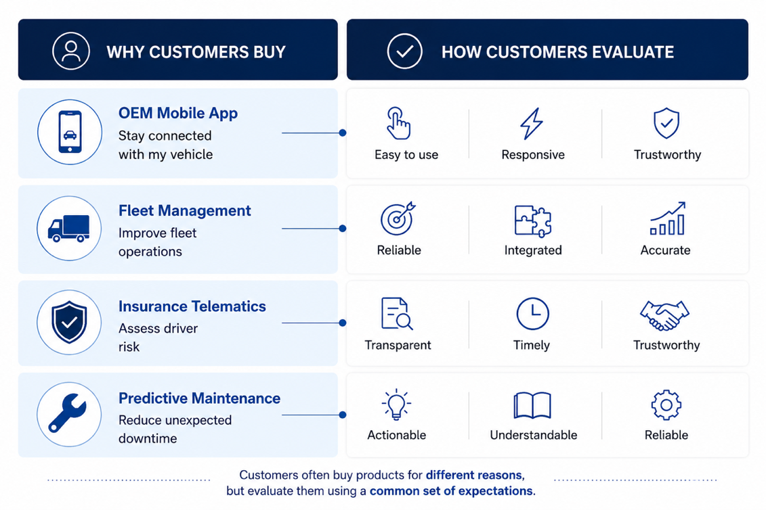
Figure 1: Customer’s buy vs evaluation
Figure 1 illustrates this distinction. Customers buy different connected mobility products for different reasons, but often evaluate them using a remarkably similar set of expectations. While most products within a category deliver comparable functional value, customer preference increasingly depends on how well those expectations are met.
Designing Products Around Customer Expectations
Understanding customer expectations should not be viewed as a user interface exercise. It should become an input to product strategy. Before discussing features or writing user stories, product teams should ask a simple question: What expectations must this product satisfy to become the customer’s preferred choice? The answer will vary depending on the customer.
- A vehicle owner may value simplicity and responsiveness above everything else.
- A fleet operator may place greater emphasis on reliability and integration.
- An insurer may prioritize trust, transparency and data accuracy.
These priorities influence not only the user experience but also product architecture, operational processes, documentation, onboarding and customer support. Products that ignore these expectations may still function correctly, but they rarely become products that customers enjoy using or recommend to others.
A Better Way to Think About Product Success
As connected mobility continues to mature, functional differences between competing products are becoming smaller. Most products within the same category can perform similar tasks. This means that competitive advantage increasingly comes from meeting customer expectations better than competitors. Customers may initially choose a product because it solves their problem. They continue using it because it is reliable. Because it is easy to use. Because they trust it. In other words, customers don’t remember products simply because of their features.
They remember how those products made them feel while accomplishing their goals. For solution providers, this creates an important shift in thinking.
Building better connected mobility products is no longer just about adding new capabilities. It is about understanding the expectations customers use to judge those capabilities. The companies that master both will build products that customers not only adopt but continue to trust, recommend, and use.
The next time you review your roadmap, don’t just ask What new features are we building? Ask Which customer expectations are we improving? The answer may explain why customers choose your product over another with similar capabilities.