
Over the past decade, connected mobility has evolved into one of the fastest-growing segments of the automotive industry. Today, hundreds of companies describe themselves using terms such as connected vehicle, telematics, fleet management, vehicle intelligence, software-defined vehicle, mobility platform, and connected services. While these terms reflect the industry’s rapid evolution, they are often used inconsistently and frequently overlap, making it difficult to understand what a company actually does, who it competes with, or which customers it serves.
Whenever a product manager, business analyst, consultant, or investor comes across a company in the connected mobility ecosystem, understanding the company’s business requires looking beyond the terminology used on its website. Regardless of whether the company is an OEM, a startup, a Tier-1 supplier, or a software provider, asking the following five questions provides a structured way to understand its customers, value proposition, offerings, and role within the connected mobility ecosystem.
- who are their customers ?
- What problem do they solve?
- What do they actually offer?
- What makes them different?
- Where do they fit in the end-to-end connected mobility ecosystem?
“Understanding a connected mobility company starts not with its technology, but with the right questions.”
Question 1: Who are their customers?
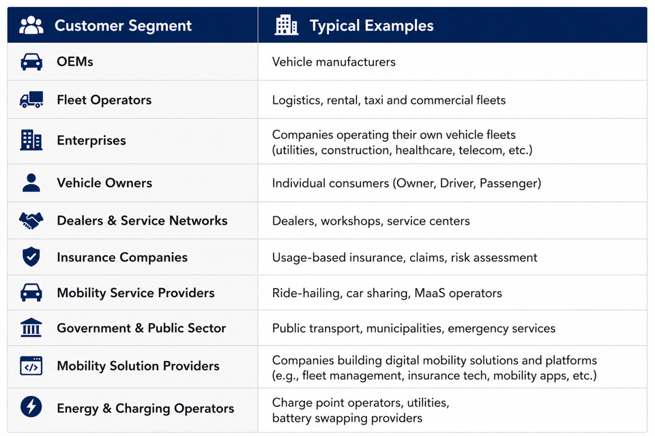
Every connected mobility company exists to create value for a specific set of customers. Understanding who pays for its products or services is often the fastest way to understand the company’s business model, priorities, and market positioning. While many companies describe themselves using technical terms such as telematics, connected vehicle, or AI-powered mobility platform, these labels reveal little about the business unless the intended customers are also understood.
In the connected mobility ecosystem, companies typically serve one or more of the following customer segments:
A company may target multiple customer segments, but there is usually one primary customer group that drives its products, services, and commercial strategy.
Understanding the customer segment provides valuable context for interpreting the company’s products, partnerships, competitors, and overall market position.
Question 2: What problem do they solve?
A company’s products, technologies, and marketing messages may change over time, but the underlying business problem it solves is often much more stable. Identifying that problem provides valuable insight into the company’s purpose, target market, and long-term strategy.
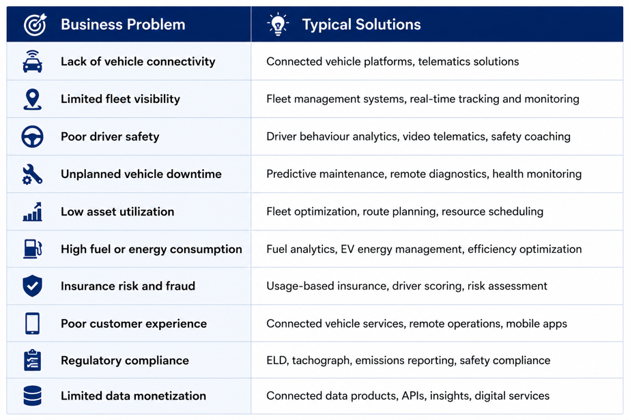
Many companies describe themselves using terms such as connected vehicle platform, AI-powered analytics, telematics, or fleet intelligence. While these describe the solution, they do not necessarily explain the business problem being addressed. Customers invest in connected mobility solutions because they need to solve specific operational or business challenges.
Common business problems addressed by connected mobility companies include:
A company may solve multiple business problems, but there is usually one primary problem that defines its value proposition and market positioning. Understanding that primary problem often provides a clearer picture of the company’s business than simply looking at its products or marketing claims.
Question 3: What do they actually offer?
After identifying a company’s customers and the business problems it solves, the next step is to understand what customers are actually buying. In the connected mobility industry, companies often describe themselves using broad terms such as platform, ecosystem, AI-powered mobility, or digital transformation. While these terms help position the company in the market, they do not always explain its primary commercial offering. In client discussions, many companies pitch themselves as ‘platform’ businesses when their actual revenue comes from hardware or managed services. Asking what the customer signs a contract for — a device, a subscription, or a service SLA — usually reveals the real offering.
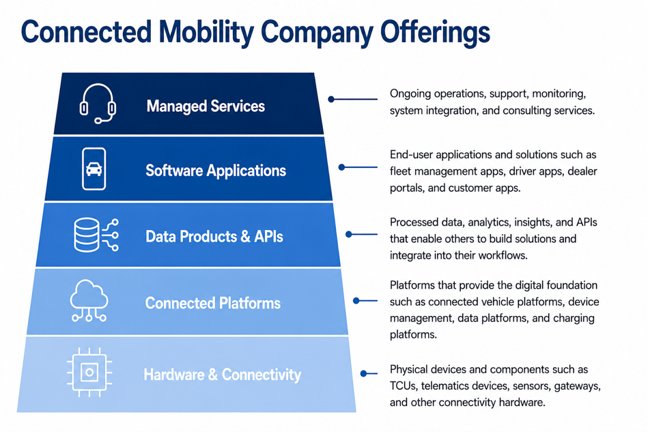
Companies that solve similar business problems may deliver value in very different ways. One company may sell hardware, another may provide a software platform, while a third may offer data products, engineering services, or managed services. Understanding the company’s primary offering provides a clearer picture of its business model and how it creates value for customers.
Although many companies provide multiple products and services, there is usually one primary offering that defines how the company creates value for its customers.
Although marketing terminology varies across the industry, identifying the company’s primary offering helps distinguish what customers are actually buying from how the company chooses to position itself.
Question 4: What makes them different?
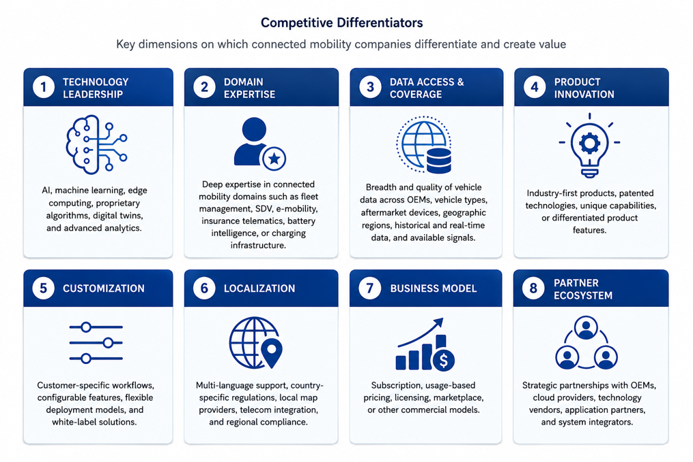
In practice, it is very common to find multiple companies providing connected vehicle platforms, fleet management solutions, telematics services, charging platforms, or software-defined vehicle technologies. However, their competitive advantage often lies not in what they offer, but how they deliver value. Understanding a company’s differentiators helps explain why customers choose it over competitors and how it positions itself within the market. These differentiators may be based on technology, business expertise, access to data, product innovation, business model, or strategic partnerships.
Companies often differentiate themselves through a combination of these factors rather than a single capability.
Knowing their primary differentiators provides valuable insight into their competitive positioning, strategic focus, and long-term market advantage.
Question 5: Where do they fit in the end to end connected mobility ecosystem?
No connected mobility company operates in isolation. Every company is part of a broader ecosystem where it collaborates with customers, suppliers, partners, and technology providers to deliver value. Understanding a company’s role within this ecosystem provides important context that goes beyond its products or services. Some provide foundational technologies, while others develop business solutions or deliver mobility services to end users.
An important characteristic of the connected mobility ecosystem is that companies often play multiple roles simultaneously. A company may be a customer of one connected mobility company while acting as a solution provider or service provider to another. For example, a mobility solution provider may purchase connected vehicle data from another company to build fleet management or insurance solutions. Likewise, a mobility service provider may consume multiple connected mobility solutions while delivering transportation services to passengers or businesses. A company’s role therefore depends on where it participates within the ecosystem and the value it creates for other participants.
Understanding a company’s ecosystem role helps answer questions such as:
- Who are its upstream suppliers, technology partners, and data providers?
- Who are its downstream customers and end users?
- What value does it create within the connected mobility ecosystem?
- How does it collaborate with other ecosystem participants?
- Is it primarily a customer, a provider, or both?
Looking beyond products and technologies enables a deeper understanding of how companies collaborate, compete, and create value across the connected mobility ecosystem. Together with the previous four questions, this provides a practical framework for analyzing any connected mobility company, regardless of its size, geography, or market segment.
Bringing It All Together
The connected mobility industry continues to evolve rapidly, with new companies, technologies, and business models emerging every year. While terminology may differ across websites and marketing materials, asking the right questions provides a consistent way to understand what a company actually does and the value it brings to the ecosystem.
By examining who a company serves, the problems it solves, what it offers, what differentiates it, and where it fits within the connected mobility ecosystem, product managers, analysts, consultants, and business leaders can move beyond marketing terminology and develop a more structured understanding of the market.
Rather than relying on marketing terminology alone, this framework encourages readers to evaluate connected mobility companies through a consistent business lens. As the connected mobility ecosystem continues to evolve, asking the right questions remains one of the most effective ways to understand any company, regardless of its technology, geography, or market segment.